How to use a planner with ADHD, and keep using it
Most planners are built for people who plan every hour and never skip a day. If that's not you, change the planner, not yourself.
The short answer: keep the daily list tiny (three must-dos), plan in loose blocks instead of hours, empty your head onto a brain-dump page, and use an undated planner so a skipped week never wastes pages. Missing days is normal. Just start again on today's page.
Why ordinary planners stop working
Many people with ADHD buy a planner, use it hard for two weeks, then stop. Usually the planner asks for too much: a 20-line to-do list, an hourly grid, a page for every date. One busy week leaves a row of blank pages that feel like failure, and the planner goes in a drawer. A planner that fits ADHD asks for less and forgives more.
Three must-dos, not twenty
Each morning (or the night before), pick the three things that would make the day count. Write everything else somewhere else. Three is short enough to start and finish, and finishing builds the habit. Done more? Write it on a done list: seeing what you did beats staring at what you didn't.
Time blocks instead of hours
An hourly grid breaks the first time a task runs long. Plan the day in three or four loose blocks instead: morning, after lunch, late afternoon, evening. Put one or two tasks in each. If a block slips, the next one is still there.
When you estimate how long something takes, double it. Time blindness makes almost everyone underestimate, and a doubled estimate stops the whole day from falling over.
A brain dump to empty your head
When thoughts pile up (calls to make, things to buy, ideas, worries), write them all on one page without sorting. Then pick at most one or two for today's must-dos and leave the rest on the page. Your head gets quieter because nothing is lost.
Break big tasks down until the first step is obvious
"Do taxes" won't get started. "Find last year's tax letter" will. Split a big task into steps small enough that the first takes under ten minutes, and put only that first step on today's list.
A dopamine menu for low-energy days
Write a short menu of things that lift your energy, grouped like a restaurant menu: starters (two minutes: a song, a glass of water, stepping outside), mains (a walk, a shower, calling a friend) and desserts (things to enjoy in moderation, like a show). On a flat day, pick from the menu instead of scrolling.
Why undated is better
An undated planner has no printed dates, so you write the date when you use a page. Skip a week and there are no blank pages left behind: you just carry on. You can also start any month, not only in January.
A kind weekly review
Once a week, take five minutes: what went well, what got in the way, one thing to try next week. No grades and no catching up on missed pages.
A planner built this way
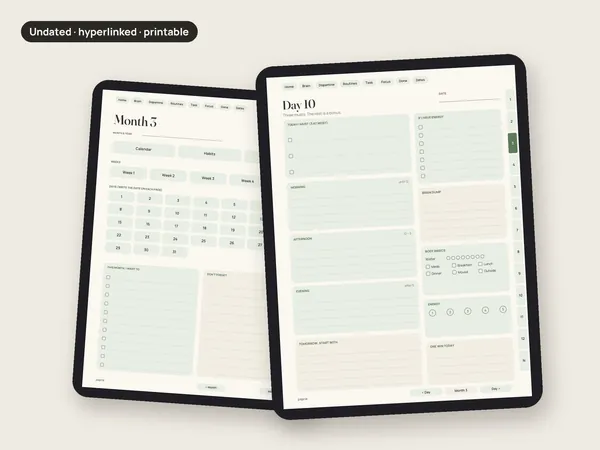
Our undated ADHD planner has all of this ready: daily pages with three must-dos, time blocks, an "if I have energy" list and a done list, plus brain dump, dopamine menu, task breakdown with a doubled time estimate, routines, focus sessions and a mood and energy tracker. It comes as a hyperlinked planner for GoodNotes, Notability or Samsung Notes and as printable pages in US Letter and A4. New to tablet planners? Read how to use a digital planner.
These are planning tips, not medical advice. If ADHD makes daily life hard, a doctor or ADHD coach can help.